After the two disappointing cozy fantasy romances, it was something of a relief to turn to Kamila Shamsie’s Salt and Saffron. Not fantasy. Just plain, ordinary Life. Sort of. Not my ordinary Life, but someone’s.
This was a cheat-read: it did not come from my library shelves, but from the local library. I have another Shamsie on my shelves, awaiting a reread, from my MA course: Home Fire, which I liked enough to pick up Salt and Saffron when I saw it in the library.
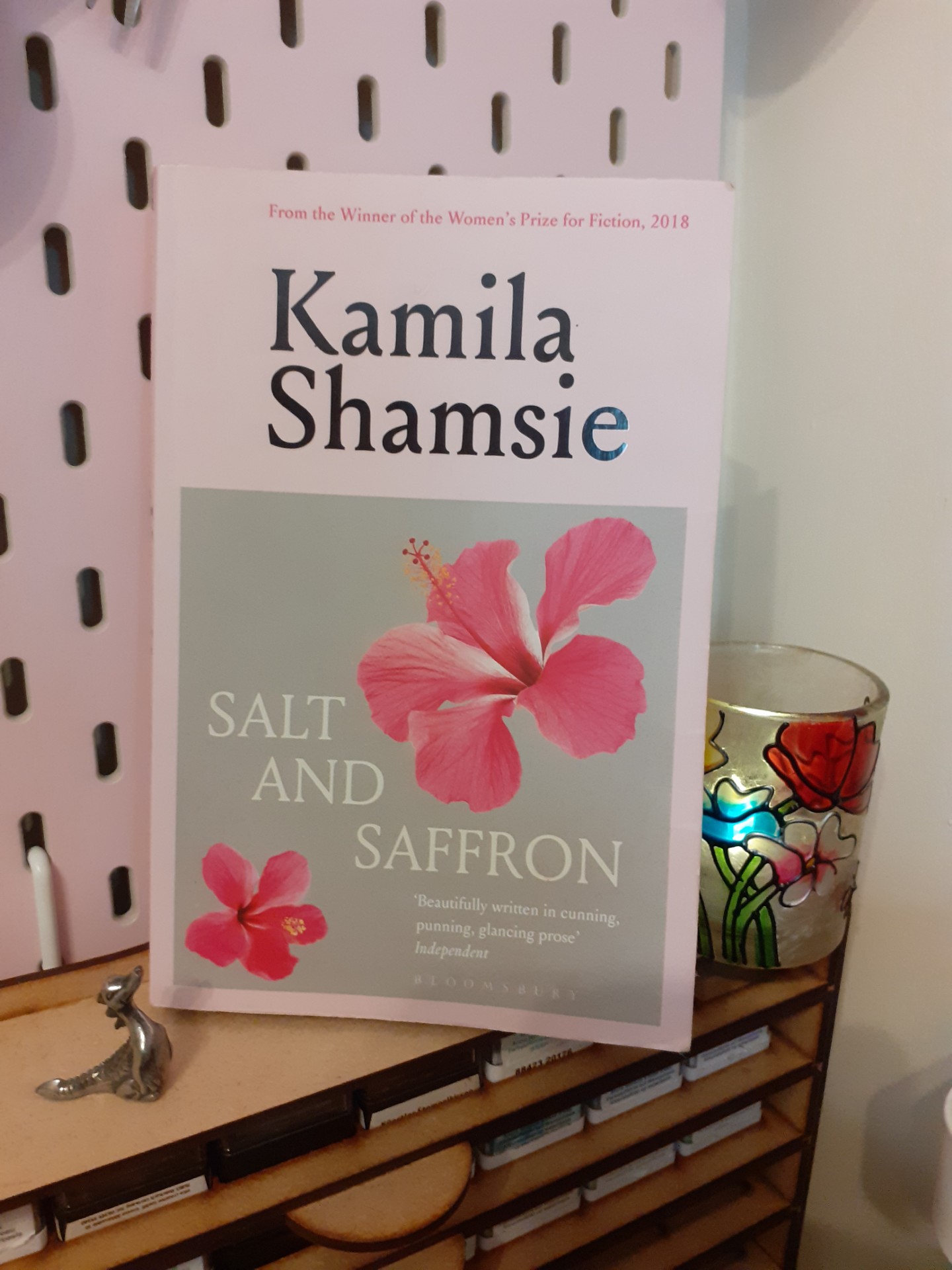
Salt and Saffron is about families and family stories. The legends and prejudices that pass through the generations and colour attitudes and behaviours. Predestination or free will. Love across society.
This particular family, the Royal Family of Dard-e-Dil, has a thing about twins, or almost-twins, and the troubles they cause. Their history covers Partition, with some in Pakistan and some still in India. No longer talking, because of the politics which led to the split. But there is some contact between generations for whom this is less of an issue.
The narrator, Aliya, meets someone on the plane to London. Someone also from Karachi – but from the Wrong Part of Karachi. And she is led to consider herself a twin with her black sheep of an aunt, Mariam. Will she bring scandal and ruin on the family in the same way as Aunt Mariam, for the Boy from the Wrong Part of Karachi?
I like Shamsie’s writing. She has a very lyrical way with her words, which draws you (OK, me) in and keeps you (me) reading. Without being sparse, she is not excessive. Sensible length novels. In theory, even a busy person could probably read one in a single evening. Given a chance, I’d have done this. I didn’t, but it’s the sort of book which weaves that sort of spell. Creates an atmosphere in my mind. Smells and tastes of Karachi food.
And there was less of the silly behaviour, despite protagonists of similar ages. Reasonably sensible people (because we all have our own sillinesses, but mostly we outgrow the sort that belong in school). Certainly no impulse to chuck it across the room in exasperation.
If this weren’t a library book, it would be a keep. As it is, it went back to the library. But I wouldn’t disdain to purchase if I came across it in a shop. Or for my Kindle, which is mostly full of duplicates for travelling purposes.
This post includes Amazon affiliate links. This simply means when you click on the links I might earn a commission, but there is no additional cost to you. Other bookshops and editions are, of course, available.

