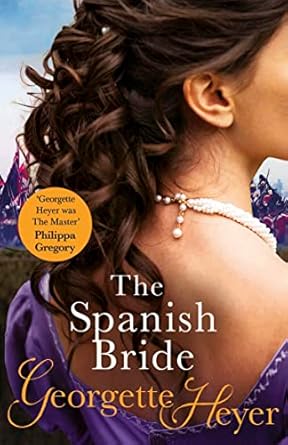
Published in 1940, The Spanish Bride follows the real-life story of Harry and Juana Smith, from their meeting after the siege of Badajos in 1812 through to the battle of Waterloo in 1815.
Apparently, it was an early ambition of Heyer’s, to write the Smiths’ story, but she did nothing with it until she was offered the opportunity to read the unpublished diaries of Sir George Scovell, Wellington’s spy-chief, some time around early 1939. And then worried about the timing, since it was largely written and then published in the early months of World War Two.
Despite being rejected for serialisation on the grounds that it was a bit heavy for a wartime audience, Heyer was pleased, on reviewing the manuscript, that it wasn’t just “one dam’ battle after another”. It so easily could have been, although I think it reads more of an adventure-story than a romance, however much Heyer might have said there was plenty of the love-stuff in it.
Harry and Juana fall in love basically on sight, and the main complications to their marriage come from the army, particularly when Harry is sent to America and can’t take Juana with him, and Juana’s anxiety each time waiting to hear if he will return to her. There are no real potential rivals, although Juana does rail at Harry for flirting with another lady at a ball. This is even more of a military novel than An Infamous Army was, the focus being the Peninsular campaigns. Heyer drew heavily on Harry’s autobiography, cross-referenced with other Riflemen’s memoirs, such as John Kincaid’s (present at Harry and Juana’s meeting) and Private Costello’s (for the experience of the rank and file soldier).
Having written Waterloo in An Infamous Army, however, in The Spanish Bride, Heyer stays with Juana, who is sent with the baggage-train to Antwerp. There are besides enough other sanguinary battle-fields to describe in the years following Badajos (including the sacking which followed the siege: an interesting opening to what is marketed as a romance novel). It isn’t just about the battles, though, and there are amusing moments in the billets, especially when a Padre joins their household after Madrid.
I’ll admit, I haven’t read this one as often as some of the other Heyers. It is, perhaps, a bit harder going than most of them: I can see why it was rejected for serialisation, given the timing. But it’s still worth a read. Even more interesting was a quick scan through Harry’s autobiography while I was reading it, and a subsequent glance at some of the other memoirs: for the essentials, very few liberties taken. Of course, Heyer did pride herself on her research and historical accuracy.
This post includes affiliate links. This simply means when you click on the links I might earn a commission, but there is no additional cost to you. Other bookshops and editions are, of course, available.

