Published in 1951, The Quiet Gentleman is a less obvious romance. It centres primarily on the question of whether or not someone might be trying to murder Gervase, the seventh Earl of St. Erth, and, if they are, who it might be.
Returning to the family seat a year after inheriting (because if he’d returned any earlier, he’d have had to go into mourning for his father, and he couldn’t bring himself to do that), he finds a not-quite-loving household to greet him. The building, a sprawling mass of a castle, doesn’t help, with its draughts and corridors a mile long.
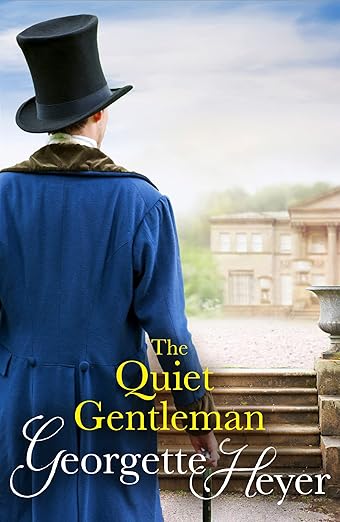
In residence Gervase finds his stepmother, the Dowager Countess, his half-brother Martin, his cousin Theo, his stepmother’s chaplain, Reverand Clowne, and a visitor, prosaic Drusilla Morville. Martin (Gervase’s heir, although he looks on Gervase as a usurper) makes no bones about the fact that he regrets Gervase, a veteran of Wellington’s Army, not dying in battle, and even the Dowager expresses surprise at his survival.
Martin is even more disgusted by the discovery that Gervase is a “curst dandy”, and the Dowager by Gervase’s refusal to wear his father’s signet ring, the only item of unentailed property not otherwise bequeathed to Martin. Besides all this, Gervase favours his mother, a woman who had run off with a notorious rake before Gervase was out of leading-reins and then died a few years later in squalid circumstances. If the Dowager (who has shades of Austen’s Lady Catherine de Bourgh) is anything to go by, I suspect the sixth Earl may have been…shall we say, difficult to live with?
Complications arise when Gervase happens across the beautiful heiress, Miss Marianne Bolderwood (thrown from her horse, and no groom by), with whom all the young gentlemen in the area are in love, Martin currently the favourite.
And then he’s not. Just one more thing to lay at Gervase’s door.
Despite her beauty, Marianne is not destined to be the heroine of the piece. She’s just a flighty young distraction, designed to cause yet more problems between Gervase and hot-tempered Martin.
The Quiet Gentleman doesn’t normally top lists of Favourite Heyer Novels. It was published the year after The Grand Sophy, which does, which probably doesn’t help. But I like the quietness of both the hero and his eventual bride, Drusilla (there’s a dry interchange at the start when the chaplain asks Drusilla, who is knitting a sock, what she’s thinking. Whether the sock is long enough, is the answer), and the Lady Catherine-ness of the Dowager.
An early fan wondered if it’s quietness meant that Heyer was sad or depressed. A different sort of comedy and humour, clearly not to that fan’s taste.
This post includes affiliate links. This simply means when you click on the links I might earn a commission, but there is no additional cost to you. Other bookshops and editions are, of course, available.
 The Paper Dragon